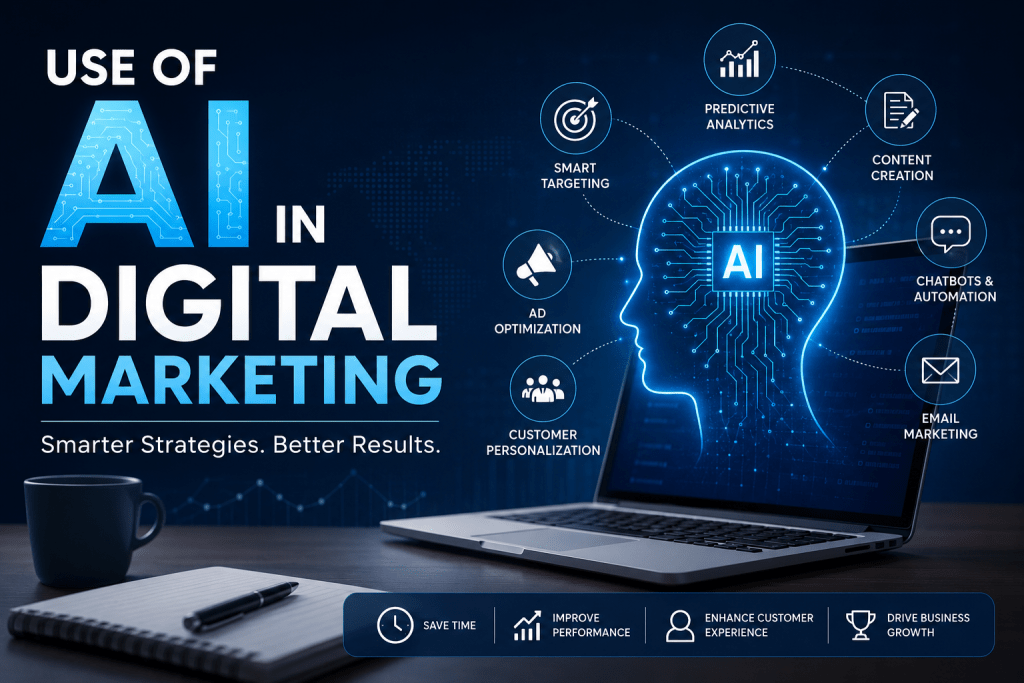
Artificial Intelligence (AI) is no longer just a futuristic concept. It has become an important part of modern digital marketing, helping marketers analyze data, understand customer behavior, automate repetitive tasks, create content, personalize campaigns, and make faster marketing decisions.
From AI-powered content creation and predictive analytics to automated advertising and intelligent chatbots, AI is changing how brands connect with their audiences.
However, the real value of AI in digital marketing is not simply about automating everything. It is about combining AI capabilities with human creativity, strategic thinking, and marketing expertise to achieve better results.
In this article, we’ll explore the use of AI in digital marketing, its major applications, benefits, challenges, and how digital marketers can integrate AI into their strategies.
What Is AI in Digital Marketing?
AI in digital marketing refers to the use of artificial intelligence technologies to collect and analyze data, automate marketing processes, identify patterns, generate content, personalize customer experiences, and support marketing decisions.
Traditional digital marketing often requires marketers to manually analyze large amounts of campaign and customer data. AI can process this information much faster and identify patterns that may otherwise be difficult to notice.
For example, AI can help marketers determine:
- Which audiences are more likely to convert
- What type of content customers are interested in
- Which advertising campaigns are performing well
- When customers are most likely to engage
- Which leads deserve greater attention
- What marketing messages may resonate with different audiences
Instead of replacing digital marketers, AI can act as a powerful assistant that helps them work more efficiently.
How Is AI Used in Digital Marketing?
AI has applications across almost every major digital marketing channel. Here are some of the most important ways marketers are using it.
AI-Powered Content Creation
Content creation is one of the most popular applications of AI in digital marketing.
AI tools can assist marketers with creating:
- Blog post ideas
- Article outlines
- Social media captions
- Advertising copy
- Email subject lines
- Product descriptions
- Landing page content
- Video scripts
- Headlines and CTAs
Generative AI can significantly reduce the amount of time required for brainstorming and producing initial drafts.
However, publishing AI-generated content without proper review is rarely a good strategy.
Effective content still requires human input to ensure accuracy, originality, brand consistency, audience relevance, and a natural writing style.
The strongest approach is:
AI for speed + Human expertise for quality and strategy.
AI in Search Engine Optimization (SEO)
AI is also changing the way marketers approach SEO.
Digital marketers can use AI to assist with keyword research, search intent analysis, competitor research, content planning, topic clustering, content optimization, and identifying potential content gaps.
For example, instead of creating content around individual keywords alone, marketers can use AI to understand related questions and topics users may search for throughout their buying journey.
AI can also help analyze existing website content and identify opportunities to improve its structure, readability, relevance, and topical coverage.
But AI does not eliminate the fundamentals of SEO.
Technical SEO, quality backlinks, website performance, user experience, helpful content, authority, and a strong understanding of search intent remain important.
AI should therefore support an SEO strategy rather than become the entire strategy.
AI in Paid Advertising
Paid advertising platforms have been using machine learning and automation for years.
AI can support advertising campaigns by helping with audience optimization, bidding, budget allocation, creative variations, campaign analysis, and conversion prediction.
For marketers managing Google Ads or Meta Ads campaigns, automation can process thousands of signals and make optimization decisions at a scale that would be difficult to manage manually.
Marketers can also use generative AI to quickly develop multiple versions of:
Primary Text → Headline → Description → CTA
These variations can then be tested to understand which messaging works best with the target audience.
The marketer’s role, however, remains critical.
AI may optimize based on available data, but marketers still need to define campaign objectives, develop offers, understand customers, track lead quality, interpret results, and make strategic decisions.
Customer Segmentation and Personalization
Not every customer has the same interests, needs, or buying behavior.
AI enables marketers to analyze customer data and create more meaningful audience segments.
Customers can potentially be segmented according to factors such as:
- Previous purchases
- Website activity
- Content engagement
- Demographics
- Product interests
- Customer lifecycle stage
- Lead behavior
Marketers can then deliver more relevant content, offers, recommendations, and advertising experiences to different segments.
Consider an e-commerce website.
A new visitor, a returning customer, and someone who abandoned a shopping cart should not necessarily receive the same marketing message.
AI-powered personalization can help businesses create different experiences for each customer type.
AI Chatbots and Customer Support
Customers increasingly expect businesses to respond quickly.
AI-powered chatbots can provide automated responses to common customer questions and assist users outside normal business hours.
Chatbots can be used for:
- Answering frequently asked questions
- Collecting customer information
- Generating leads
- Recommending products or services
- Scheduling appointments
- Providing basic support
- Directing users to relevant resources
For lead-generation businesses, chatbots can also act as an initial qualification layer.
For example, a real estate chatbot might ask:
What type of property are you looking for?
What is your preferred location?
What is your budget range?
When are you planning to purchase?
This information can help sales teams prioritize and follow up with relevant prospects.
Predictive Analytics
One of AI’s most valuable capabilities is identifying patterns within large datasets.
Predictive analytics uses historical data and statistical or machine-learning models to estimate future outcomes.
Digital marketers can use predictive insights to better understand:
- Conversion probability
- Customer churn
- Lead quality
- Purchasing behavior
- Campaign performance
- Customer lifetime value
- Product demand
Instead of making decisions based entirely on assumptions, marketers can use data-driven predictions to support their strategy.
It is important to remember that predictive models are not guaranteed forecasts. Their usefulness depends heavily on the quality, quantity, and relevance of the underlying data.